
 Insert HTML here
Turis Kampungan
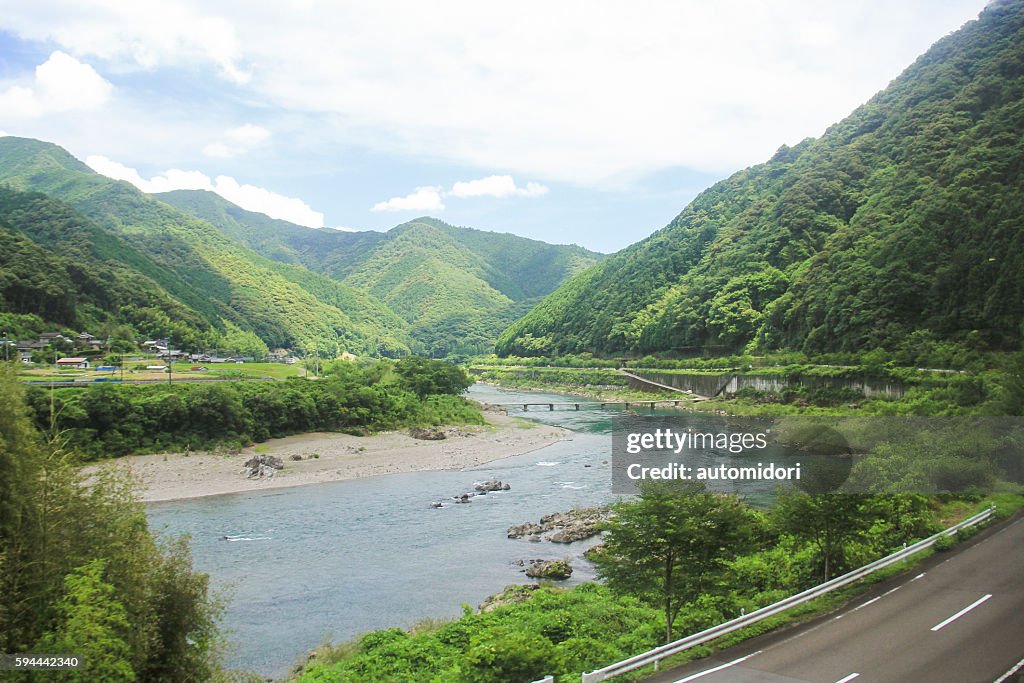
Among the many train routes I have taken across Japan, the one between Uwajima and Kubokawa is, for me, the most scenic. The landscape along the Shimanto River felt more like China than Japan. I can run the scene from my train window through my head a hundred times. But there’s one moment I’ll never forget.
The passenger seats were arranged alongside the windows, so we sat with our backs to the windows. Passengers had to turn their heads to see the scenery, or enjoy the view through the window across the aisle.
When the Shimanto River came into view, I was completely stunned. However, I told myself, “Don’t act ‘kampungan’. That’s just a normal river, except to you.”
A few moments later, a gentleman sitting next to me turned his head toward me.
“Hora! The river! River! It’s beautiful, isn’t it? Hora!”
The way he said it was almost like, “Are you blind, or what?”
“Yes, it’s beautiful,” I replied.
“Then why don’t you shoot with your camera? Hora!” he said, sounding rather irritated.
Because it was inconvenient to shoot over my shoulder, I knelt on the seat so I could point my lens straight ahead. But then came another problem: reflections on the window. By the time I found an angle free of reflections, the train had already gone around another curve.
So I got up and opened the window above me.
Yeah! Got it! Yuhuyyy!
You can’t imagine how thrilled I was.
But that did not last long. My train stopped.
The train engineer slid his door open and walked straight toward me. My heart stopped.
He reached up to the window above my head and pulled it down. In a very polite Japanese but firm tone, he told me that the windows were not to be opened. I apologized. He returned to his cabin. Our train moved on.
I continued taking pictures through the closed window. It was super challenging. I couldn’t get a single decent photo.
Then our train stopped again. This time, it was for a break. I don’t remember the name of the station. But then, once again, the train engineer came to me.
This time, he told me that I had to remain seated while the train was running. If I didn’t, he said, the next train engineer would have to ask me to get off the train. His tone was rather harsh.
This photo here is the only decent one I managed to get. The true journey was a tenth as beautiful as this.
Notes
Kampungan — Kampung originally means “village” in Indonesian. Kampungan, derived from kampung, describes someone or something considered unsophisticated, uncultured, or lacking urban manners—literally, having the characteristics of someone from a village. It can be used teasingly or somewhat disparagingly, depending on the context. Here, I used it to mean “acting like an unsophisticated tourist.”
Hora (ほら) — A Japanese expression used to draw someone’s attention to something, roughly meaning “Look!”, “There!”, or “See?”. In this story, the gentleman used it repeatedly to point out the Shimanto River.
Have you ever tried so hard not to look like a tourist that you ended up looking even more like one? 😄

Leave a Reply